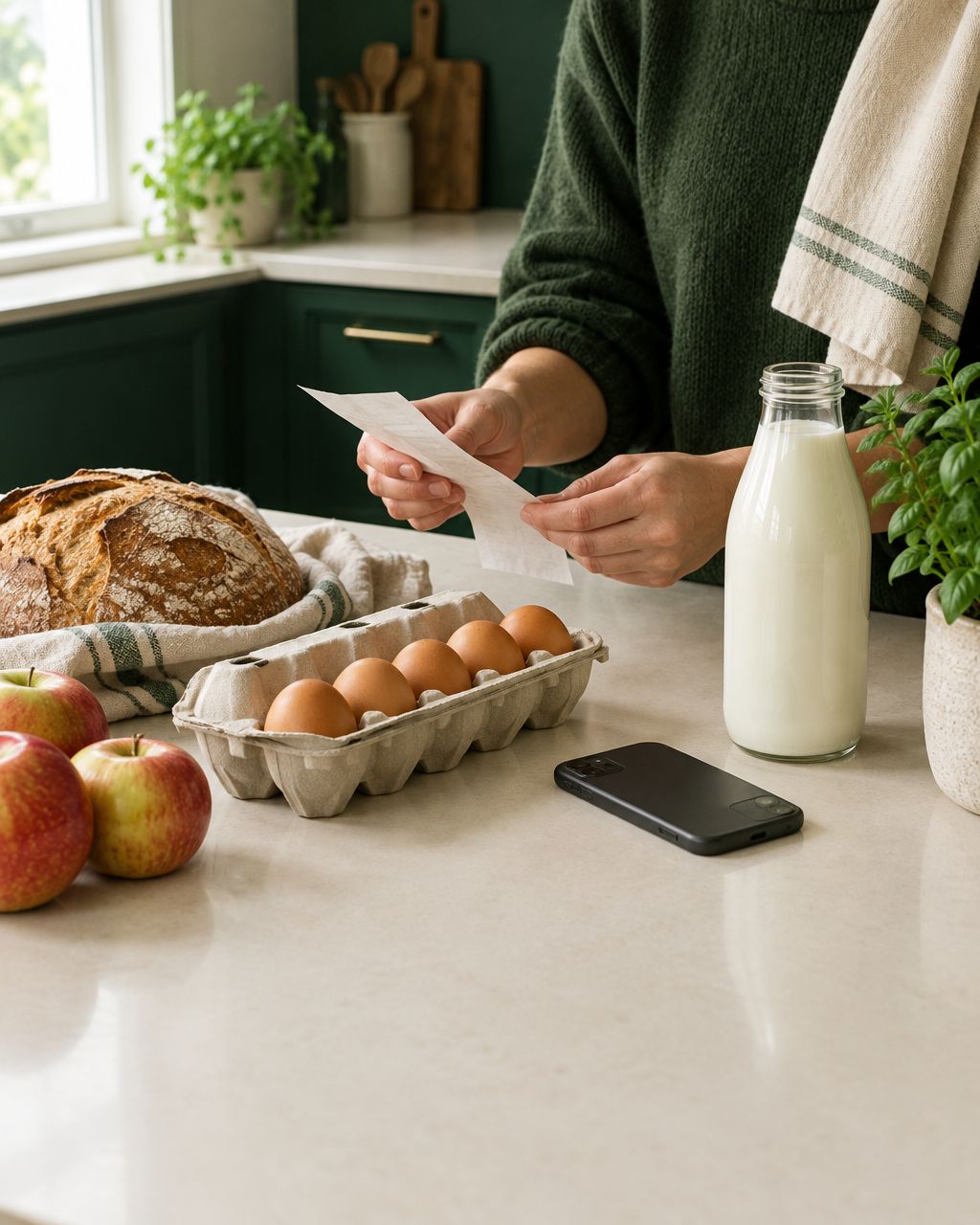
For families tired of remembering the same groceries every week, the best grocery list app should help prepare the list—not just hold it. CartCycle takes that approach: it learns from your household's grocery receipts, predicts recurring items, and drafts a next cart for you to approve, skip, or adjust.
- The best grocery list app for repeat shopping helps you start with your household's routine, not an empty page.
- CartCycle turns uploaded grocery receipts into context for a reviewable next-cart draft.
- Milk, eggs, bread, and household essentials belong in the planning picture—not just ingredients for dinner.
- You approve, skip, or adjust suggestions; CartCycle never orders automatically.
What makes the best grocery list app for a busy family?
For repeat grocery shopping, look for help remembering what belongs on the list before you begin typing. A place to record items is useful. A starting point based on what your household regularly buys addresses an earlier part of the job: bringing those items back to mind.
Think about preparing for your next trip. Dinner ingredients might be easy to remember because you have a recipe in front of you. The less visible work is everything around those meals: breakfast milk, lunchbox snacks, cereal, yogurt, and the toilet paper someone mentioned yesterday.
Those purchases form part of your household's rhythm. Household grocery planning becomes easier to discuss when that rhythm has a visible starting point instead of living entirely in one person's head.
When choosing an app, look for these qualities:
- A useful starting point: something more grounded than a generic list of groceries.
- Attention to repeat purchases: help with items your household comes back to.
- An understandable process: a clear connection between purchase history and suggestions.
- Room for changing weeks: a way to approve, skip, or adjust what is proposed.
- Control over what you buy: you make the buying decisions.
These are the needs behind CartCycle's learn, predict, review approach. The purpose is not to make your grocery routine more complicated. It is to give the remembering part somewhere to live.
The blank-list problem starts before you type
You open your list and begin again. Milk. Eggs. Bread. Something for breakfast. Something for lunches. Then you try to remember whether there was another household essential you meant to replace.
The items are familiar, but assembling them still takes thought. You can recognize a staple instantly when you see it and still forget to write it down while planning the trip. That is why storing a list and helping prepare a list are different jobs.
For a family of four or five, there are several routines to hold together. One person eats cereal, someone else prefers eggs, and school snacks belong on the list even when they have nothing to do with dinner. The person making the shopping list has to remember what everyone needs.
Your household already has purchase history. It should be able to help you plan your next trip to the grocery store. Instead of treating each trip as unrelated to the last one, a receipt-based planning approach uses previous purchases as context.
That changes the starting question. Rather than asking what you can remember from scratch, you begin with a draft and ask what fits this week. You are still making decisions, but you have something concrete to respond to.
How receipt history becomes a next-cart draft
A grocery receipt is a record of a real shopping trip. It reflects the groceries your household actually chose, rather than an imagined household or a standard shopping template.
Through uploaded receipts, a planning app can build context around recurring purchases. The useful signal is not simply that you bought milk once. It is the pattern of returning to familiar groceries across your household's shopping history.
The process is straightforward:
- Provide purchase history. Upload grocery receipts from your household's shopping.
- Let recurring purchases inform the draft. Past purchases give the prediction process a basis for estimating likely next needs.
- Review for the coming trip. Keep what fits, skip what you have enough of, and adjust for your plans.
You do not need to invent a household routine to get started. Your own purchases provide the context. The product is built around learning from that history, rather than asking you to reconstruct it entirely from memory.
This is also why the idea reaches beyond meal ingredients. Bread, milk, cereal, school snacks, and household supplies can recur for reasons that have little to do with a dinner recipe. Purchase history helps bring those repeated needs into the same planning conversation.
The value is in making that history useful for what happens next. A receipt records what you bought on your last trip to the grocery store; a draft cart helps you plan your next shopping list.
Learn, predict, review: a routine with you in control
CartCycle's grocery planning process has three parts. Each has a clear role: learn the household's history, prepare suggestions, and leave the final choice with the household.
Learn from what your household buys
Beta users upload grocery receipts to provide past purchase information. Those records give the product context about what your household buys, how often purchases recur, and the quantities in its shopping history.
The point is to start with your routine. A family that regularly buys sourdough and yogurt has different recurring groceries from a family that relies on cereal and packed sandwiches. Your history provides the starting material for your household's suggestions.
Predict what is likely to be needed next
The prediction step estimates recurring items your household is likely to need and when. Those estimates become a draft cart you can review before the next shopping trip.
This is the difference between keeping a record and putting it to work. Instead of leaving old purchases in the past, the process uses their patterns to help prepare the next decision.
Review the draft for the week ahead
You approve, skip, or adjust the suggestions. That review is where your plans meet your purchase history: familiar staples stay in view, while your current needs shape the final list.
Already have enough bread? Skip it. Expecting more breakfasts at home? Adjust the amount. Happy with a suggestion? Approve it and move on.
User review is what makes the draft flexible. You get help remembering recurring items without handing over the decision about what your household will buy.
Picture an ordinary week, not a perfect one
Imagine a household preparing its regular grocery trip. Milk, eggs, yogurt, and sourdough are familiar purchases. This week, there is still bread in the kitchen, but more people will be eating breakfast at home.
A draft informed by recurring purchases gives those staples a place to start. You can see them together, consider the coming week, and make the adjustments that fit. The history supplies context; you supply today's decisions.
Here is an illustrative review—not a recommended shopping quantity or a promised prediction result:
| Familiar item | What is different this week | Your review decision |
|---|---|---|
| Milk, usually bought in a 1-gallon carton | More breakfasts at home | Review the amount for the coming week |
| Eggs, usually bought in a 12-egg carton | Enough remain for planned meals | Skip this cycle if no more are needed |
| Sourdough bread | A loaf is already at home | Leave it off your shopping list |
| Yogurt | The usual breakfast routine continues | Approve if the amount fits |
The useful part is having these familiar items in front of you. You can decide what belongs on the next list without first trying to bring every repeat purchase back to mind.
This is a planning example, not a claim that every household buys on the same schedule. Your groceries and your decisions remain your own. A personalized starting point makes room for that difference.
A different starting point from a traditional list
A manually written list and a receipt-based draft start at different stages of the same task. The first begins with what you remember to enter. The second begins with suggestions informed by what your household has bought before.
| Planning approach | Best for | Where the list begins | What you decide |
|---|---|---|---|
| Manually written list | Recording groceries you have already identified | The items you remember to add | Every item and quantity from the beginning |
| Receipt-based predictive draft | Preparing recurring household groceries | Suggestions informed by purchase history | Which suggestions to approve, skip, or adjust |
The advantage of a predictive draft is its starting material. Your household's routine contributes to preparation before you make the final decisions.
There is a practical responsibility alongside that advantage: receipt-based planning needs uploaded purchase history, and suggestions need your review. It is designed to support planning, not measure everything currently in your cupboards or order on your behalf.
That boundary is simple. CartCycle never orders automatically. You can use a next-cart draft with the reassurance that a suggestion is not a purchase.
Why this matters for families with repeat grocery trips
Shopping for a household involves more than deciding what sounds good for dinner. It means remembering the ordinary things that keep breakfast, lunches, snacks, and home life moving.
Those groceries rarely arrive as one neat request. Someone finishes the cereal. Someone asks for yogurt. A household supply runs low. By the time you make the list, the information may be spread across several moments in the week.
A purchase-history starting point gives you a way to approach the recurring part of that work. It does not require every familiar grocery to be newly remembered before it can be considered again.
For families of four or five, that distinction is the reason to consider a predictive grocery app. The goal is not a longer list or another system to maintain for its own sake. It is a more grounded beginning to a task you already do.
Look at the groceries you repeatedly bring home:
- Breakfast staples such as milk, eggs, cereal, or yogurt.
- Bread and other familiar lunch ingredients.
- Snacks that return to the household routine.
- Recurring household essentials.
When those are the items you keep rebuilding into a list, a reviewable draft directly addresses the problem. You begin with context, then make the list your own.
Help shape the Founding Beta
CartCycle grew from a familiar family problem. Founder Ryan Spencer describes the effort of keeping groceries organized for a large family: remembering what is running out, rebuilding the same lists, and trying not to forget something on each trip.
The question behind the product is straightforward: why can't your past grocery shopping help plan your next trip? Its receipt-based prediction and review process puts that question into practice.
The Founding Beta brings households into shaping that experience. You can try the process with your own grocery history and contribute feedback as the prediction experience develops.
Begin with your real routine rather than buying different groceries just to try the app. Familiar groceries make the purpose easy to recognize: how your past purchases help prepare a draft, and how your review turns it into something suitable for the coming trip.
You are not being asked to give up control of shopping. You are helping shape a way to make the repeat-planning work less dependent on memory.
FAQ
What should the best grocery list app do for a busy family?
For a family with recurring purchases, it should help prepare the list as well as record it. A draft based on purchase history gives familiar groceries a starting point, while the household decides what fits the next trip.
How does CartCycle help with remembering repeat groceries?
CartCycle learns from your household's past purchases and predicts recurring items for a reviewable next-cart draft. You begin with suggestions informed by your routine instead of rebuilding every familiar item from memory.
How do I provide my grocery purchase history?
Beta users upload grocery receipts. Those receipts supply information about previous purchases so the planning process can learn from the household's shopping history.
Can I skip or change a predicted item?
Yes. You approve, skip, or adjust suggestions before shopping. That lets you keep familiar purchases in view while adapting the draft to the week ahead.
Will the app automatically buy the groceries it predicts?
No. CartCycle never orders automatically. The predicted cart is a draft for your review, not an order.
Is this just a list of ingredients for recipes?
The approach is based on household purchase history rather than only on recipes. Its purpose is to help prepare recurring groceries, including everyday staples and household essentials.
What is the Founding Beta for?
The Founding Beta lets early households help test and improve the prediction experience. It is a chance to try receipt-based grocery planning with your own routine and help shape the product.
One last thing: your next list need not begin empty
If the hardest part of grocery planning is remembering the same items again, look beyond a place to type them. Look for a starting point that draws on your household's routine and leaves the final decisions with you.
CartCycle is built for families who want help remembering recurring groceries while keeping control of what goes on their shopping list. Learn from past purchases. Predict what is likely to be needed. Review what fits now.
Apply to join the Founding Beta and help shape a grocery planning experience that starts with your household—not a blank page.